

Laura has 8 years of experience in investment in emerging countries. After starting her career as a fundraiser with the NGOs Mandap Travels in Nepal and Dar Al Amal in Lebanon, Laura joined Proparco, the private sector financing arm of Agence Française de Développement.

‍
Based in Morocco for 2 years, she was in charge of prospecting and origination for Proparco projects in North Africa (Mauritania, Morocco, Algeria, Tunisia, Egypt). She then joined the teams at Proparco’s head office in Paris as an Investment Officer for Africa and the Middle East.

‍
In total, Laura has been involved in about twenty transactions, at all stages of the financing process: strategic, financial and impact analysis; field due diligence, drafting of investment memoranda, presentation to the committee, negotiation of legal documentation, closing and portfolio monitoring.

‍
Laura graduated from Sciences Po Paris in Public Affairs and from Audencia Nantes in Corporate Finance.

‍
She joined Removall as Director of Project Development & Investment and is in charge of project development & investment in carbon projects with high environmental, economic and social impact financed by Removall.

Home
Resources
Resources
Blog
Blog

Introduction to the Voluntary Carbon Market in Africa

Key Trends and Opportunities

Introduction to the Voluntary Carbon Market in Africa
Details
Summary
Author

As global awareness of climate change intensifies, the Voluntary Carbon Market has emerged as a vital tool for countries to mitigate greenhouse gas emissions. In Africa, where the effects of climate change are increasingly apparent, the VCM presents an opportunity to invest in projects that sequester carbon, enhance livelihoods, protect biodiversity, and foster resilience.

The Rising Influence of Africa in the Global Voluntary Carbon Market

While the VCM in Africa started relatively slowly — with the first credits issued on the continent dating back to 2003, compared to 1996 globally — Africa’s influence in the global carbon market has been steadily increasing. According to the Berkeley Carbon Trading Project’s Voluntary Registry Offsets Database (2024)*, the number of credits issued and retired in Africa has grown significantly between 2018 and 2024, respectively multiplying by 3 and 4 (graph below).

As a result, the share of African projects in the annual global credits issued has risen from 13.5% in 2018 to 25% in 2023. This represents a remarkable growth trajectory, as the continent increasingly attracts investment and interest from international companies seeking to offset their emissions.

* The database tracks carbon offset projects, credit issuances, and retirements across four major registries: American Carbon Registry (ACR), Climate Action Reserve (CAR), Gold Standard, and Verra (VCS).

Overview of the Voluntary Carbon Market in Africa

Today, the voluntary carbon market in Africa is thriving, with projects spanning across renewable energies (wind, solar, geothermal), energy efficiency, reforestation, sustainable agriculture and community-based projects (cookstoves, clean water). The 2024 Berkeley Database suggests that more than 2,000 African projects have issued credits since the market’s inception. These projects have collectively issued 300 million carbon credits (equivalent to around $2.2 Bn**), with 151 million retired to offset emissions ($1.2 Bn). The majority of these credits have been registered under two main standards: the Verified Carbon Standard (VCS) – 66.5%, and Gold Standard – 33.5%.

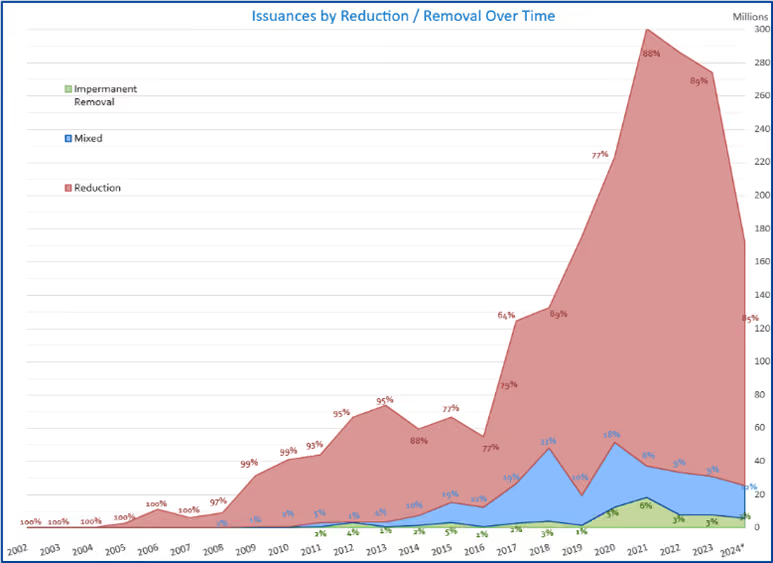
Similarly to the rest of the world, the bulk of carbon credits in Africa are derived from emission reductions or avoidance (85%), with only a small proportion of credits linked to mixed credits (12%) and even fewer to pure removals (3%). This makes removal projects and Nature-Based Solutions particularly rare and attractive to investors on the continent.
Sectoral breakdown: a predomiance of large conservation forestry projects and community initiatives

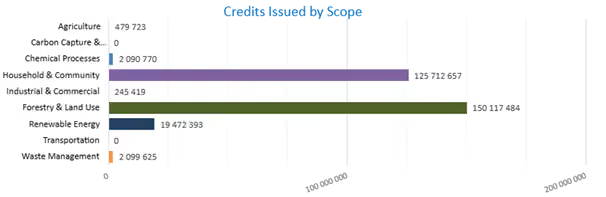
In terms of project typology, the forestry and land-use sector remains dominant in Africa, accounting for 50% of the credits issued. This is primarily driven by  forest conservation projects (88%), with a lesser proportion attributed to reforestation or sustainable grassland management.

The second key sector in Africa is household and community-based projects, which represent 42% of total credits issued. These are mostly driven by clean cookstoves (78%), with other notable contributions from clean water initiatives (10%), energy efficiency programs (5.8%), and community boreholes (5.6%).

Renewable energy projects, though still limited, account for 6.5% of credits issued.
Regional breakdown: East Africa Takes the Lead

In terms of regions, East Africa leads the market, accounting for 44% of Africa’s projects, with Kenya alone representing 50% of that total. Southern Africa follows with 29%, Central Africa makes up 14%, and West Africa 12%, while North Africa contributes just 1%. Key countries with the highest number of carbon offset projects include Kenya (296 projects), Uganda (250), Rwanda (204), Malawi (131), and Madagascar (119).

**Pricing reference MSCI

Recent Regulatory Developments

The Africa Carbon Market Initiative (ACMI) is a pioneering initiative aimed at accelerating the development of carbon markets across Africa. Launched in 2023, it is part of the broader effort to support the continent’s contribution to global climate action. The primary goal of the ACMI is to create a robust and transparent carbon market infrastructure to enable African countries to tap into the growing global demand for carbon credits.

In line with this initiative, several African countries have made significant strides in establishing and refining their carbon regulatory frameworks in the past few years.

In East Africa, Kenya has introduced the Climate Change Act (2016) and completed it with the newly released Climate Change (Carbon Markets) Regulations (2024). Both documents create a legal framework for carbon trading and outlines procedures for the development of carbon offset projects. Rwanda also appears as a country favourable to carbon investors, with one of the first Corresponding Adjustments approval released globally on a carbon project.

In Southern Africa, South Africa has made notable progress with its carbon tax policy, which includes provisions for companies to offset a portion of their tax liabilities through investments in certified carbon projects (Department of Environmental Affairs, South Africa, 2019). Mozambique has also established a clear and favourable legal framework to implement carbon projects with the Decree No. 23/2018.

In West Africa, Ghana has implemented the Ghana Forest Investment Programme (GFIP), which focuses on enhancing forest management and conservation (Ghana Forestry Commission, 2019). This program supports the development of carbon credits from reforestation and afforestation projects.

The evolution of these carbon regulations is significantly impacting the landscape for carbon offset projects in Africa, encouraging other countries to also work a clearer legal frameworks and supportive policies.

Challenges and Opportunities

Despite the positive developments, several challenges persist in the regulatory landscape. Unclear or complex regulatory requirements or heavy compliance costs are prohibitive for both project developers and investors. Small and local entities lack the expertise needed to navigate complex regulatory requirements (Huang et al., 2020).

However, these challenges also present opportunities for growth. Looking ahead, the future of the voluntary carbon market in Africa appears promising. As regulatory frameworks continue to evolve, they will likely encourage increased investment in carbon projects, enhance project credibility, and align national efforts with global climate goals.

Current Status of African Carbon Projects and Future Prospects

Despite their importance and potential, there are still relatively few removal carbon projects in Africa that generate carbon credits.

Removall, committed to advancing the African carbon initiative, has been developing and investing in African carbon projects for over three years. Nearly 40% of the projects in the portfolio are based in Africa. Some of these projects have already been certified and generated their first carbon credits in 2024, including credits with corresponding adjustments. Significant investments have been made in projects in Mozambique and Rwanda, while additional opportunities are currently being developed in Tanzania, Uganda, Rwanda, Kenya, Ghana, Madagascar, and other countries.

In line with our commitment to the continent, Removall recently opened an office in Nairobi to strengthen operations, better identify new project opportunities, and improve the management of investments in the region. This strategic move will help scale up the impact and continue driving sustainable development across Africa.

Conclusion

It is crucial to remember that carbon offset projects in Africa are not just about environmental outcomes; they are deeply tied to development, the livelihoods of local communities and biodiversity. These projects often support the preservation of ecosystems, enhance agricultural productivity, provide clean energy, and improve health outcomes—directly impacting the lives of millions of people.

Unfortunately, at times, the ongoing debates and criticisms around carbon market integrity, and the complexities of environmental standards in developed countries can overshadow the urgent need for greater investment in Africa’s carbon projects. While these debates are important, they must not detract from the immediate need to channel more financing into projects that can deliver both environmental and social benefits. The reality on the ground is that for many African countries, the voluntary carbon market offers a rare opportunity to address both climate change and development challenges in tandem.

References

  • Berkeley University, Voluntary Registry Offsets Database v2024-08-31. The database, developed by the Berkeley Carbon Trading Project, contains all carbon offset projects, credit issuances, and credit retirements listed globally by four major voluntary offset project registries—American Carbon Registry (ACR), Climate Action Reserve (CAR), Gold Standard, and Verra (VCS).
  • Department of Environmental Affairs, South Africa. (2019). Carbon Tax Act.
  • Ghana Forestry Commission. (2019). Ghana Forest Investment Programme (GFIP).
  • Government of Kenya. (2016). Climate Change Act.
  • Huang, J., et al. (2020). « Challenges in Carbon Market Development in Africa. » Environmental Science & Policy, 107, 89-95.
  • MSCI pricing database.

‍

DISCOVER OUR OTHER ARTICLES

SBTi Corporate Net-Zero Standard Version 2.0
Regulation & Standards
Carbon Market Insights

SBTi Corporate Net-Zero Standard Version 2.0

What really changes for corporate carbon strategies

00
min

The Science Based Targets initiative has released its Corporate Net-Zero Standard Version 2.0, marking a clear evolution in how corporate climate action is structured and assessed.

While the foundation remains unchanged, deep emissions reductions across Scopes 1, 2 and 3 remain the priority, the new standard introduces important refinements in how companies are expected to implement, report and take responsibility for their emissions.

More importantly, it provides a clearer signal on the future role of carbon credits and removals in corporate net-zero strategies.

A shift from ambition-setting to implementation accountability

One of the most significant changes is the increased focus on implementation.

Companies are now expected to explicitly connect their science-based targets to real operational decisions, including transition planning, procurement strategies and investment cycles.

The standard introduces a “best-efforts” principle, requiring companies to use all reasonable levers within their control, disclose constraints and dependencies, and explain how barriers are being addressed.

Clearer structure across Scopes 1, 2 and 3

The updated framework requires a more structured approach:

  • Scope 1 and Scope 2 must now be addressed separately, with full coverage required
  • Scope 1 reductions may follow multiple pathways (absolute, intensity-based or transition-based)
  • Scope 2 requirements are strengthened, particularly around low-carbon electricity sourcing

Scope 3 is maintained as the most flexible but critical component, with companies required to prioritise material emissions sources and integrate them into targets or transition plans.

Carbon credits remain excluded from target achievement

Carbon credits cannot be used to:

  • reduce reported emissions
  • demonstrate progress toward targets
  • substitute operational decarbonisation

Even where companies miss targets, SBTi only recommends voluntary purchase of removals as an additional action, without allowing them to count toward target achievement.

Ongoing Emissions Responsibility (OER)

The new OER framework introduces voluntary recognition for companies contributing to climate action beyond their own value chain emissions.

Three levels exist:

  • Engaged (≥1%)
  • Advanced (≥10% incl. Scope 1 & 2)
  • Leadership (full Scope 1–3 coverage with financial contribution requirement)

Companies may use either verified mitigation outcomes or a financial contribution mechanism.

Post-2035 removal trajectory

From 2035 onwards, companies are expected to support removals equal to:

  • at least 1% of ongoing emissions
  • increasing linearly to 100% by net zero (2050 latest)

A key distinction is introduced:

  • long-lived greenhouse gases → long-lived removals
  • other emissions → short- or long-lived removals

This creates a structural shift toward durability-based carbon accounting

10% long-lived removals requirement

From 2035, at least 10% of covered emissions linked to long-lived greenhouse gases must be addressed with long-lived removals.

This share increases progressively to 100% by the net-zero year.

This reinforces a clear market signal toward durable carbon storage solutions.

No reliance on a single credit quality standard

The framework does not anchor eligibility to specific labels such as CCP.

Instead, it relies on principle-based integrity criteria:
additionality, permanence, leakage control, MRV robustness, and safeguards.

Corresponding adjustments and Article 6

SBTi recommends that companies prioritise credits not simultaneously claimed under national NDCs.

Where possible, companies are encouraged to use credits backed by corresponding adjustments under Article 6, improving the integrity of net-zero claims and reducing double counting risk.

What this means for corporate carbon strategies

Three structural shifts stand out:

  • From target-setting to implementation accountability
  • From offsetting logic to strict separation of roles
  • From generic credits to durability-based carbon removal strategies

Conclusion

SBTi V2.0 does not fundamentally change the direction of corporate climate ambition. It clarifies how it must be implemented.

Net zero is no longer only a target framework. It is becoming an operational responsibility framework, combining emissions reduction with structured climate contribution.

Sources

  • Science Based Targets initiative (2026), Corporate Net-Zero Standard Version 2.0
  • Science Based Targets initiative (2026), Introducing the SBTi Corporate Net-Zero Standard Version 2.0
  • Science Based Targets initiative (2026), SBTi Corporate Net-Zero Standard V2.0 – Guidance and supporting documents
  • Science Based Targets initiative (2026), Net-Zero Standard implementation materials and FAQs
  • United Nations Framework Convention on Climate Change (UNFCCC), Article 6 of the Paris Agreement – Corresponding Adjustments Guidance
To all the sustainability leaders in logistics
Carbon Market Insights
Corporate Climate Action

To all the sustainability leaders in logistics

As a key player in the logistics sector, your company is undoubtedly aware of the growing emphasis on sustainability and the critical role that carbon offsetting plays in meeting environmental targets. Carbon offsetting is particularly important for companies within the logistics industry. Let’s go deep into some fundamental insights:

Addressing High Carbon Footprints in a Carbon-Intensive Sector

The logistics sector, encompassing road, maritime, and air transport, is a significant contributor to global greenhouse gas (GHG) emissions, accounting for approximately 23% of global CO₂ emissions from energy use. With increasing demand for freight and passenger transport, the sector faces mounting pressure to reduce its carbon footprint. While the priority in a robust climate strategy is always the reductions of your own GHG emissions, carbon offsetting provides an additional practical approach for mitigating the impact of your unavoidable emissions, by supporting or investing in projects that either remove carbon from the atmosphere or prevent equivalent emissions elsewhere. This includes reforestation, renewable energy projects, and other initiatives that align with the goals of reducing net emissions.

Aligning with Regulatory Requirements and Sustainability Goals

As regulatory frameworks around carbon emissions tighten globally, particularly in regions like the EU with its Emissions Trading System (ETS), logistics companies must adopt robust strategies to manage their emissions. In addition to ambitious emissions reduction action plans, carbon offsetting offers a flexible and cost-effective way to meet compliance requirements and support broader sustainability goals, such as those outlined in the UN Sustainable Development Goals (SDGs). Offsetting complements other decarbonization efforts, such as enhancing operational efficiency and transitioning to low-emission technologies.

Meeting Stakeholders’ Expectations and Enhancing Corporate Reputation

With rising expectations from consumers and investors, companies are under pressure to show tangible environmental commitments. For logistics companies, often seen as major emitters, carbon offsetting demonstrates accountability and helps foster trust. Beyond compliance, it allows companies to show leadership by aligning with sustainable business practices that resonate with customers and stakeholders.

Mitigating Risks and Preparing for a Low-Carbon Future

Offsetting emissions helps logistics companies navigate the evolving regulatory landscape and avoid potential financial penalties associated with carbon pricing mechanisms. It also allows businesses to take proactive steps toward future compliance with stricter regulations, positioning them as leaders in sustainability within their industry. This forward-thinking approach helps companies not only manage current risks but also capitalize on emerging opportunities in a low-carbon economy.

Why is Removall the right partner for you?

Removall stands out as a comprehensive solution provider in the carbon offsetting space, specifically tailored to meet the unique needs of logistics companies. As a project developer with hands-on experience, we bring deep, on-the-ground knowledge to every project, ensuring that our verified offset offerings—ranging from nature-based solutions to advanced carbon capture technologies—not only compensate emissions but also contribute to broader environmental and social goals.

Our rigorous project selection is supported by market-leading due diligence processes, guaranteeing high standards and long-term impact. As a mission-driven company, we view carbon offsetting as a tool for impact investing. Beyond carbon reduction, our projects provide tangible social and environmental co-benefits, measured and monitored over time. These outcomes are documented in our impact report, reflecting our commitment to transparent, lasting contributions aligned with the SDGs.

Partnering with Removall means integrating offsetting seamlessly into broader sustainability strategies, aligning with regulatory requirements and positioning for future carbon regulations. With strong sectoral expertise, particularly in transport and logistics, we support our clients with both short-term contracts and long-term partnerships, securing high-quality project supply and price stability. Together, we go beyond meeting current obligations, empowering companies to lead in sustainability, enhance their reputation, and achieve a competitive edge in a rapidly evolving market. We are eager to explore how our tailored solutions can help your company not only offset its emissions but also contribute positively to communities and the environment, paving the way for a sustainable future.

00
min
Removall's CSR approach
Corporate Climate Action
Project Insights & Impact

Removall's CSR approach

In France today, less than 50% of SMEs are committed to a CSR approach, and almost 40% are unfamiliar with the concept. Yet it is key to achieving sustainable development objectives that private players commit to improving their impact.

At Removall, we have around 25 employees and have put in place a simple CSR approach that we would like to share, to demonstrate that it is possible to have a positive impact even on a small scale.

As a company committed to the environment and a company with a mission, we were keen to develop a rigorous internal CSR policy in line with the values we uphold in our business.

Here are the key stages:

Structuring our approach

  • We began by setting up our CSR Committee in October 2022, made up of volunteer members from each of Removall’s teams. The committee holds monthly progress reviews and quarterly meetings with management.
  • Since 2023, we have been using the framework suggested by Ecovadis to better structure our approach around the Environment, Ethics, Social and Governance pillars. It is thanks to the feedback from this assessment that we have been able to progressively improve our approach. Today, we are proud to be among the top 6% of companies with the most serious CSR approach.

Involving employees in the process

  • It’s important to raise awareness of our CSR approach within the company, and to involve as many volunteers as possible. Every newcomer to Removall receives a guide to best practices for reducing his or her daily impact at work, and is trained in the workings and actions of the CSR committee. We ensure that all CSR resources are always accessible to employees (charters, policies, reports, etc.).
  • We also organize awareness-raising campaigns (themed displays and training courses) and solidarity actions (clothing drives, solidarity team-buildings in aid of associations) to get employees as involved as possible and share useful knowledge.

Tracking our actions

We attach great importance to measuring not only our impact, but also our progress. That’s why, by collecting data throughout the year, we measure our carbon footprint and waste emissions. These data are then aggregated in our sustainable development report and our Carbon Footprint, which is carried out each year in accordance with the ADEME method. We compare our results with those of the previous year, and define our work objectives for the coming year.

Offsetting our carbon emissions

To perfect our approach, we offset our residual emissions using our expertise in carbon projects to select quality initiatives to support, which we submit to an internal vote to offset our emissions. In this way, we take care to promote projects that have both a strong environmental impact and significant social benefits.

00
min
Removall & Plastic Odyssey: Partnering for a Sustainable Expedition
Beyond Carbon

Removall & Plastic Odyssey: Partnering for a Sustainable Expedition

We are thrilled to announce our new partnership with Plastic Odyssey, a pioneering initiative that addresses plastic pollution worldwide. Through this collaboration, we are joining forces to reduce and offset the carbon emissions of their global expeditions.

Plastic Odyssey’s mission is to explore solutions for plastic waste management by traveling worldwide with their laboratory vessel, sharing knowledge, and building local recycling micro-factories. However, such a vast operation comes with a significant carbon footprint, primarily from laboratory vessel fuel consumption and business flight travels. Here’s where Removall steps in!

How does our partnership work?

By using international frameworks like the GHG Protocol and ADEME’s Bilan Carbone methodology, we precisely measure the emissions generated by Plastic Odyssey’s laboratory vessel and flight travels. We then offset these emissions by financing high-impact carbon offset projects, including renewable energy and Blue Carbon initiatives that restore marine ecosystems.

Additionally, we’re helping Plastic Odyssey estimate the carbon savings from their plastic recycling micro-factories, empowering them to create even more environmental impact through data-backed methodologies.

Why this partnership matters?

In today’s world, sustainability requires collective action. Plastic Odyssey and Removall share the same vision: creating a better future for our planet by fighting plastic pollution while actively reducing greenhouse gas emissions. Through this partnership, we aim to combine our strengths and create tangible, lasting impact.

Stay tuned for more updates on how we’re working together for a cleaner, greener future!

00
min